


Steven Forth is a principle at Ibbaka and valueIQ. Connect on LinkedIn
Many people are concerned about how the adoption of generative AI and AI agents will impact jobs. Their own jobs. People in pricing are no different.
Ibbaka speaks with a lot of people in the pricing community: practitioners, consultants, and the many people who use the products of pricing work, from Sales and RevOps, to Product and Financial Leadership. One topic that always comes up is how pricing roles are changing. This topic is so important that we are hosting a webinar with some senior people in pricing: Marcos Rivera from Pricing I/O, Mark Stiving from Impact Pricing, and Augustin Manchon from Manchon & Company.
TL:DR
AI is transforming—not eliminating—pricing roles; roles will evolve rather than disappear.
Pricing analysts are at the highest risk of AI displacement, as their routine, data-focused tasks align closely with what AI excels at (data analysis, market monitoring, financial/statistical modeling).
Strategic, customer-facing, and creative pricing roles remain essential, such as Chief Pricing Officer, Pricing Director, and Pricing Designer, due to the need for executive judgment, stakeholder management, and creative thinking.
AI removes many traditional constraints in pricing, including:
Knowledge and skill limitations
Data processing capacity
System configuration rigidity
Value quantification and communication barriers
Real-time market intelligence and segmentation impediments
Time and resource constraints
New constraints arise with AI adoption, such as:
Algorithmic transparency and explainability ("black box" AI)
Data quality and reliability dependencies
System reliability and technical risks
Ethical, bias, and compliance issues
Vendor lock-in and new cost structures
Human-AI interface and trust challenges
Future skills for pricing professionals will include the ability to interpret AI, develop value-based strategies, govern and audit AI systems, and integrate cross-functional insights.
Key recommendations: Invest in explainable and ethical AI systems, prioritize AI literacy and upskilling, combine AI-driven insights with human strategy, and focus on governance and transparency.
Potential New Pricing Roles
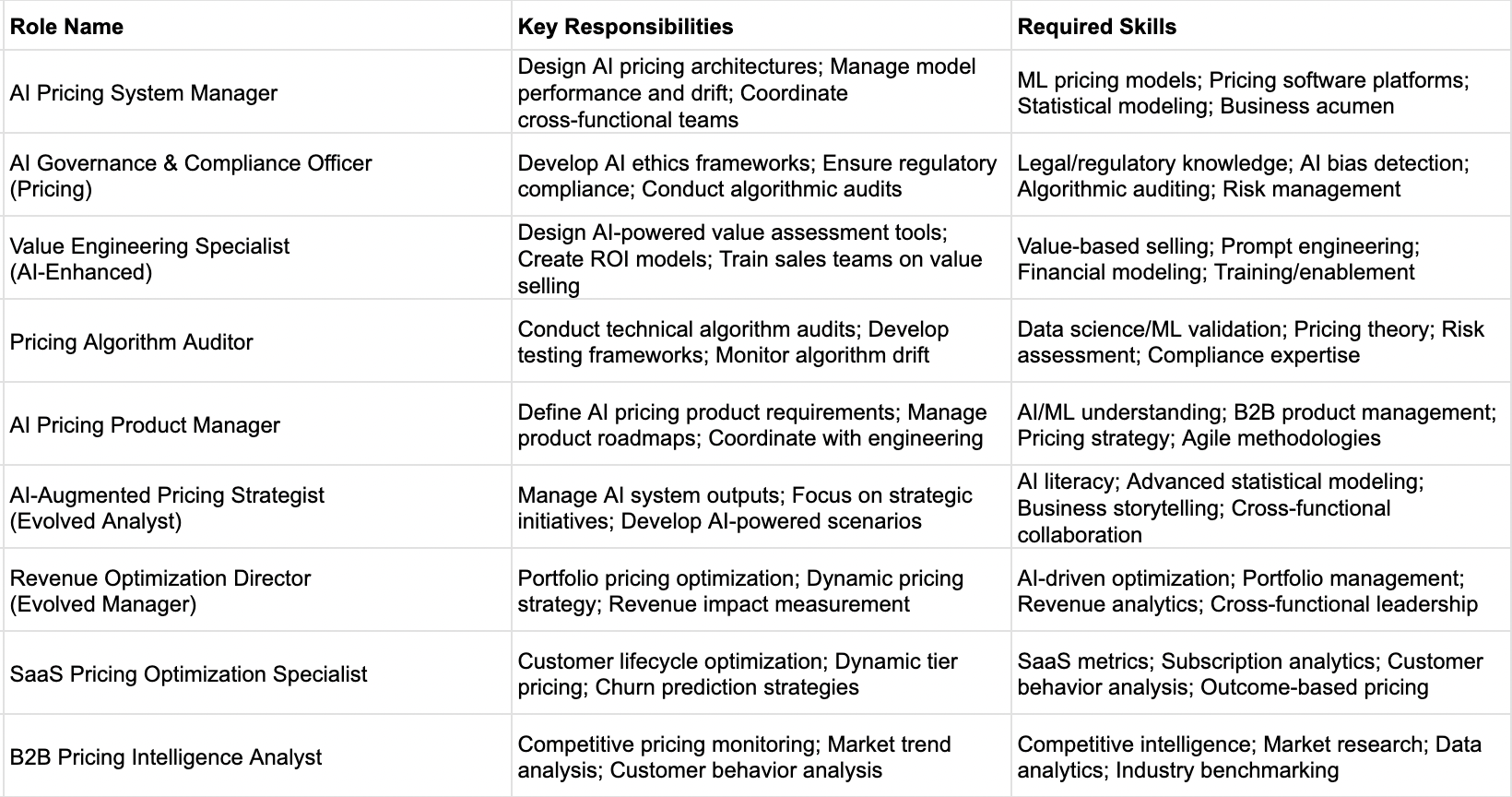
Ibbaka’s prediction on new pricing roles, September 15, 2025.
We did a poll on LinkedIn asking, “How will widespread adoption of AI impact pricing roles?” The possible answers were Eliminate Them, Diminish Them, Transform Them, and Little Impact. The poll was shared on Steven Forth’s personal feed, the Professional Pricing Society, Network of Pricing Champions, Software as a Service - SaaS Group, and AIX (the Artificial Intelligence Exchange.
The strong consensus across all groups was that pricing roles will be transformed.
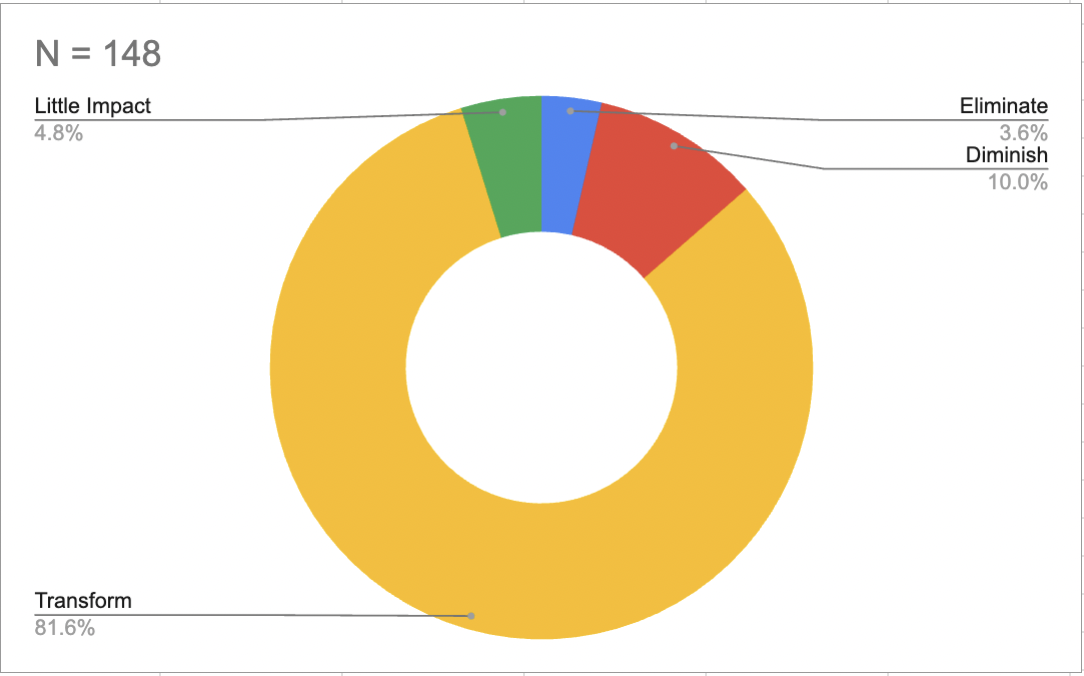
Results of Ibbaka LinkedIn Poll conducted Sept. 10 to 12, 2025. Overall Data
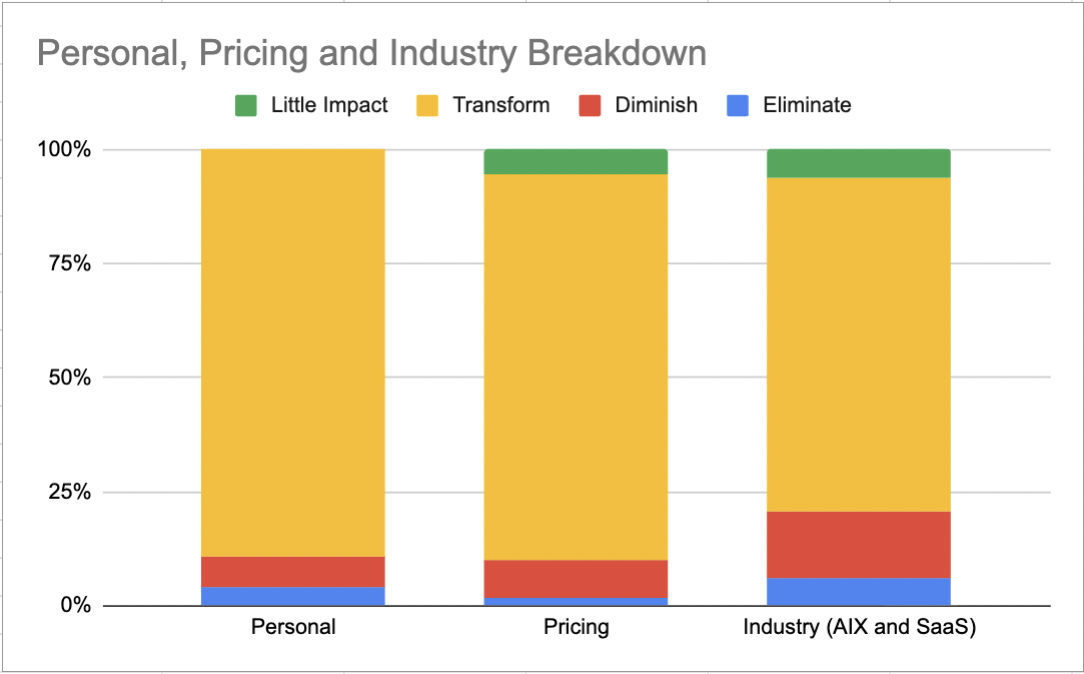
Results of Ibbaka LinkedIn Poll conducted Sept. 10 to 12, 2025. Broken down by group.
It can be useful to look at differences between groups. We bucketed the Pricing Groups (Professional Pricing Society and Network of Pricing Champions, N=73) and the Business Groups (SaaS and AIX, N = 46). Steven Forth’s connections are varied, so they were kept separate, N = 27.
Pricing people are somewhat more optimistic that their roles will not be eliminated, but the overwhelming consensus is that pricing roles will transform. But how will they transform?
Changes in adjacent roles: Sales
One place to look is in adjacent roles like sales. The chart below is from Veronika Wax at Demodesk. The model below is for a mid-sized B2B SaaS business. She is predicting about a 35% reduction in team size with some important transformations. For pricing people, the key things to note are:
The repositioning of Revenue Operations (RevOps) into GTM (Go to Market) Engineering
The complete disappearance of the RevOps Analyst role and its replacement by GTM / AI Ops Engineers, AI Trainers, and Prompt Engineers
Headcount in all other roles shrinks by 30 to 50%, which would include conventional pricing roles

The role that is closest to most pricing roles is RevOps Analysts, and when pricing people are working directly to support sales on deals, this is generally where they are placed. This is the role that Veronika thinks will go away to be replaced by GTM / AI Ops Engineers, AI Trainers, and Prompt Engineers.
Will this happen in pricing?
What are the key pricing roles and skills today?
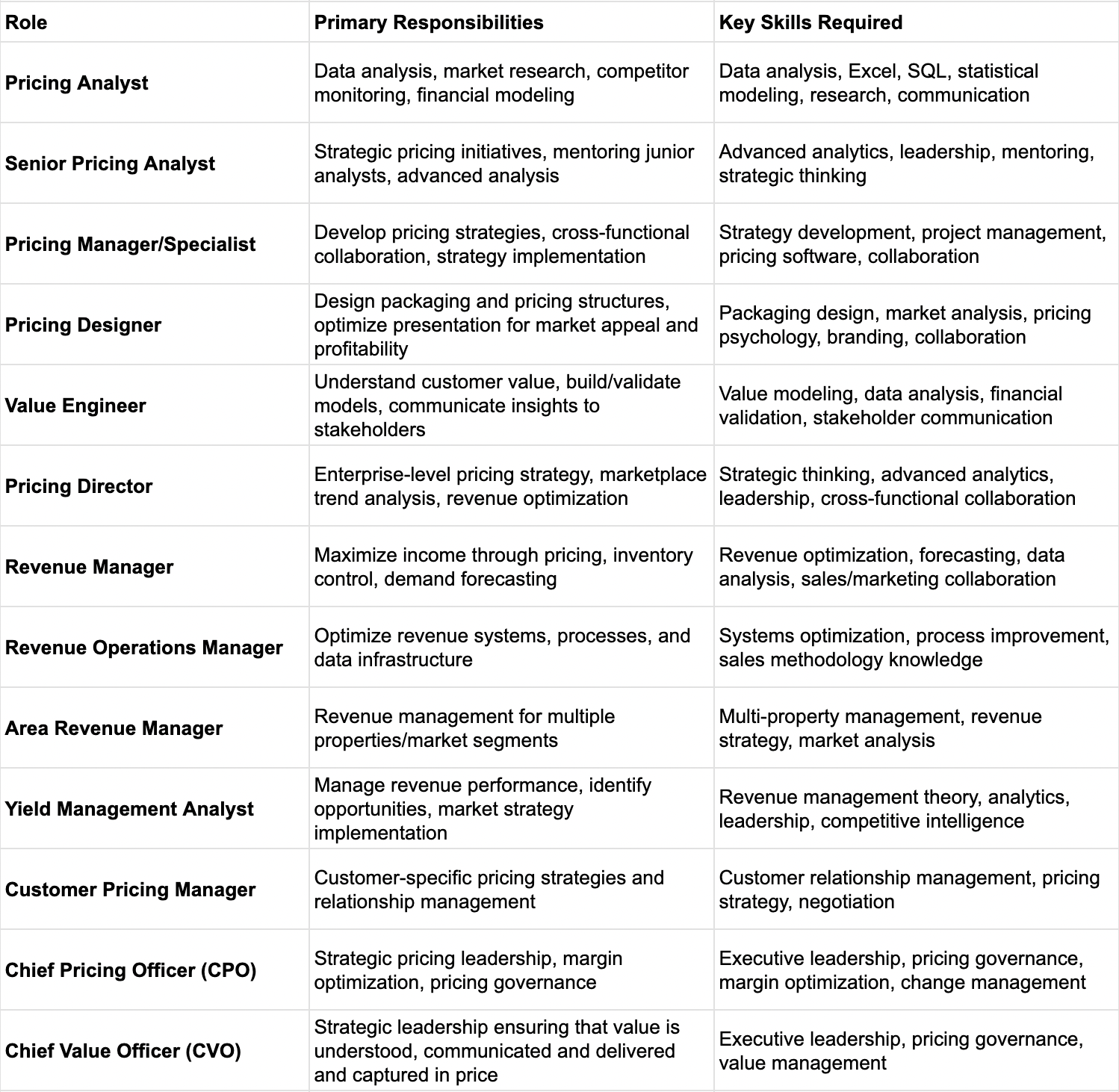
Table summarizing key pricing roles and skills in fall 2025. Prepared by Ibbaka, Sept. 12, 2025.
Pricing Analysts are at the highest risk of AI displacement among all pricing positions. Pricing Analysts perform tasks that align well with AI's current capabilities:
Data analysis and pattern recognition - AI algorithms can process vast amounts of data far faster and more accurately than humans
Market research and competitor monitoring - AI systems can continuously scrape competitor websites and analyze market conditions in real-time
Financial modeling - Machine learning models can now automate complex pricing calculations and scenario planning
Statistical modeling - AI excels at identifying patterns and correlations in large datasets
Data analysis roles face significant AI disruption. Microsoft's analysis of jobs most vulnerable to AI shows that positions involving "information processing, language-based work, routine analysis, and communication tasks" are at the highest risk. Pricing Analysts check all these boxes.
AI-powered pricing systems can now:
Automatically collect and analyze sales data, competitor prices, and market trends
Generate pricing recommendations in real-time
Perform regression analysis and demand forecasting
Create dynamic pricing models that adapt to changing conditions
The pricing industry is already experiencing major AI automation:
PROS software reports 20% revenue uplift and 90%+ accuracy in AI-driven price optimization
60%+ efficiency gains through automated pricing workflows
Companies report 5-15% increases in profit margins from AI pricing systems
Roles with Lower AI Risk
Strategic and Leadership Positions
Chief Pricing Officer (CPO) and Chief Value Officer (CVO) require executive judgment, stakeholder management, and strategic vision that AI cannot replicate
Pricing Director roles involve high-level strategy and cross-functional leadership
Customer-Facing and Relationship Roles
Customer Pricing Manager relies heavily on relationship management and negotiation skills
Area Revenue Manager requires an understanding of local market nuances and property-specific factors
Creative and Design Roles
Pricing Designer involves creative packaging design and understanding of psychological pricing factors that require human intuition
A way to think about AI transformation: Constraint changes
AI drives transformation by removing constraints. Sangeet Paul Choudary goes deep into this in his book Reshuffle: Who wins when AI restacks the knowledge economy?
He invites us to ask two related questions:
What constraints are removed by AI?
What new constraints does this surface?
The risks arise where the constraints are removed.
The opportunities emerge with the new constraints.
Let’s try to answer these questions for pricing.
What pricing constraints does AI remove?
1. Knowledge and Skills Constraints
Traditional pricing has been severely limited by human cognitive capacity and expertise requirements. Generative AI removes several critical knowledge barriers:
Complex Analysis Limitations: AI can simultaneously analyze thousands of variables that would overwhelm human analysts. Where traditional pricing teams might consider 5-10 factors, AI systems can process competitor pricing, market conditions, customer behavior, seasonality, and inventory levels in real-time.
Specialized Expertise Requirements: Value-based pricing traditionally required deep domain expertise and years of experience to implement effectively. AI democratizes this capability by automating the identification of value drivers and quantifying customer willingness to pay.
Price Sensitivity Analysis: Humans struggle to accurately assess price elasticity across multiple customer segments simultaneously. AI can continuously model and update price sensitivity relationships across thousands of SKUs and customer segments.
2. Data Processing and Analysis Constraints
The scale and complexity of modern pricing data have outpaced human analytical capabilities:
Volume and Velocity: AI systems can process vast datasets in real-time, analyzing competitor catalogs, sales velocity, inventory levels, and market conditions simultaneously. Traditional teams managing weekly or monthly updates cannot compete with systems making precise adjustments within seconds.
Pattern Recognition: Machine learning algorithms excel at identifying complex, non-linear relationships in pricing data that human analysts would miss. This includes understanding how multiple variables interact to influence optimal pricing decisions.
Predictive Analytics: AI enables sophisticated demand forecasting and price optimization that considers future market conditions rather than just historical patterns. This transforms pricing from reactive to proactive decision-making.
3. System Configuration and Integration Constraints
Legacy pricing systems have been notoriously rigid and difficult to configure:
Dynamic Pricing Implementation: Traditional systems required extensive manual configuration for dynamic pricing. AI removes these barriers by automatically adjusting prices based on real-time market conditions.
Multi-System Integration: AI can seamlessly integrate data from ERP, CRM, and external market sources that previously required complex manual processes. This eliminates the fragmented data problem that has plagued B2B pricing.
Personalization at Scale: While traditional systems struggled to implement customer-specific pricing, AI enables personalized pricing for individual customers or micro-segments without overwhelming system complexity.
4. Value Communication and Quantification Constraints
One of the most significant barriers to value-based pricing has been the difficulty in quantifying and communicating value:
Value Driver Identification: AI can automatically identify which product features and benefits drive the most value for different customer segments. This removes the guesswork and extensive research traditionally required.
Value Quantification: Generative AI can process customer feedback, usage data, and outcome metrics to quantify the economic value delivered to customers. This enables more precise value-based pricing strategies.
Personalized Value Messaging: AI can generate customized value propositions and pricing communications for different customer segments, removing the constraint of one-size-fits-all messaging.
5. Market Intelligence and Competitive Analysis Constraints
Traditional competitive analysis was limited by human capacity and time constraints:
Real-Time Competitor Monitoring: AI systems can continuously monitor competitor pricing across multiple markets and channels. This removes the lag time that previously existed in competitive responses.
Market Simulation: AI enables "what-if" pricing scenarios and market simulations that were previously impossible or extremely resource-intensive. Companies can test pricing strategies before implementation.
6. Customer Segmentation and Personalization Constraints
Traditional segmentation was limited by human analytical capacity:
Dynamic Segmentation: AI can identify and update customer segments in real-time based on behavior, value perception, and willingness to pay. This removes the constraint of static, annually updated segments.
Micro-Segmentation: AI enables pricing strategies for individual customers or very small segments, removing the constraint of broad, generalized pricing tiers.
7. Time and Resource Constraints
Traditional pricing processes were slow and resource-intensive:
Automated Price Optimization: AI removes the time constraint by continuously optimizing prices without human intervention. This enables businesses to respond to market changes in real-time rather than quarterly or annually.
Reduced Manual Labor: AI automates many pricing tasks that previously required significant human resources, from competitive analysis to price recommendation generation.
Impact of Constraint Removal on Pricing Roles
The removal of these constraints is fundamentally reshaping pricing roles within B2B software organizations:
Evolution from Tactical to Strategic
Traditional Role Constraints: Pricing analysts previously spent 70-80% of their time on data collection, competitive analysis, and manual calculations. These tactical constraints prevented focus on strategic value creation.
AI-Enabled Evolution: With AI handling tactical analyses, pricing professionals can focus on strategic activities like value proposition development, market positioning, and cross-functional collaboration. The role becomes more consultative and less transactional.
New Skill Requirements
Technical Proficiency: Pricing professionals now need to understand AI systems, interpret algorithmic outputs, and collaborate with data science teams. The ability to work with machine learning models becomes essential.
Value Engineering: As AI quantifies value more precisely, pricing roles evolve toward value engineering - helping customers understand and realize the value being priced.
System Design and Governance: New roles emerge around designing AI pricing systems, setting guardrails, and ensuring ethical AI use in pricing decisions.
Enhanced Decision-Making Capabilities
Data-Driven Insights: Pricing professionals gain access to insights that were previously impossible to generate, enabling more confident and effective pricing decisions.
Scenario Planning: AI enables pricing teams to model multiple scenarios and their impacts, transforming pricing from reactive to proactive strategy.
Cross-Functional Integration
Expanded Influence: With better data and insights, pricing professionals can more effectively influence product development, marketing, and sales strategies. The constraint of limited credibility due to incomplete analysis is removed.
Customer-Facing Roles: Some pricing professionals are moving into customer-facing roles, helping customers understand value and optimize their purchasing decisions.
What new constraints emerge when those constraints disappear?
Removing one set of constraints inevitably gives rise to new ones. These emerging limitations represent a fundamental shift from human-centered to technology-centered constraints, creating unprecedented challenges for B2B software pricing systems.
1. Algorithmic Transparency and Explainability Constraints
As AI removes human knowledge limitations, new constraints emerge around explaining and understanding AI-driven decisions:
The Black Box Problem: Advanced AI pricing algorithms operate as "black boxes" where even their creators cannot fully explain specific pricing recommendations. This creates significant challenges when customers, regulators, or internal stakeholders demand justification for pricing decisions. While humans made suboptimal pricing choices, they could at least explain their reasoning.
Regulatory Compliance Requirements: Growing regulatory scrutiny demands explainable AI systems. The EU AI Act and similar regulations require companies to explain algorithmic decisions, particularly in high-risk applications. This creates new constraints where pricing systems must balance accuracy with explainability—often a trade-off that limits optimal performance.
Customer Trust and Acceptance: B2B customers increasingly demand transparency in pricing algorithms. The inability to provide clear explanations for pricing recommendations becomes a constraint on customer acceptance and negotiation processes. Sales teams struggle to defend prices they cannot explain, limiting the practical deployment of sophisticated AI systems.
2. Data Quality and Reliability Constraints
As AI systems eliminate human data processing limitations, they create unprecedented dependencies on data quality:
Data Dependency Amplification: AI pricing systems are only as reliable as their training data, with studies showing up to 85% of AI projects failing due to poor data quality. Unlike human analysts who could recognize and work around bad data, AI systems amplify data quality issues, making pricing recommendations unreliable when based on incomplete or biased datasets.
Real-Time Data Requirements: AI-driven dynamic pricing creates new constraints around continuous, high-quality data streams. Systems that promised to eliminate time constraints now demand real-time data feeds that must be perfectly accurate and timely. Any data lag or quality degradation can lead to suboptimal or harmful pricing decisions.
Model Drift and Decay: AI models experience performance degradation over time as market conditions change. This creates ongoing constraints around model maintenance, retraining, and validation that didn't exist with static human-driven pricing approaches. Organizations must invest heavily in continuous monitoring and updating systems.
3. System Reliability and Technical Risk Constraints
The automation of pricing introduces new technical vulnerabilities:
Algorithmic Failure Rates: Multi-agent AI systems demonstrate failure rates of 60-80%, creating new reliability constraints. While human pricing teams made errors, they typically failed gradually and predictably. AI systems can fail catastrophically and suddenly, making entire pricing strategies inoperable.
Cybersecurity Vulnerabilities: AI pricing systems create new attack surfaces, with 97% of organizations experiencing AI-related breaches lacking proper access controls. The sophistication that eliminates human limitations also attracts sophisticated attacks, creating security constraints that didn't exist with simpler human-operated systems.
Integration Complexity: While AI promises to eliminate system integration constraints, it often creates new dependencies on multiple AI services, APIs, and data sources. System failures can cascade across interconnected AI services, creating brittleness that exceeds traditional system constraints.
4. Ethical and Bias Constraints
AI systems that remove human analytical limitations introduce new ethical constraints:
Algorithmic Bias and Discrimination: AI pricing can perpetuate and amplify discriminatory practices embedded in training data. Organizations face new constraints around ensuring fair pricing across demographic groups—a challenge that's technically complex and legally mandated. The Princeton Review case demonstrated how seemingly neutral AI pricing charged different prices based on ZIP codes, inadvertently discriminating against Asian customers.
Value Manipulation vs. Discovery: AI systems may learn to manipulate customer willingness to pay rather than simply discovering it. This creates ethical constraints around the boundary between optimization and manipulation, limiting how aggressively pricing systems can be deployed.
Transparency vs. Competitive Advantage: Organizations face new constraints in balancing pricing transparency with competitive advantage. While customers and regulators demand explainability, full transparency could eliminate competitive benefits from sophisticated pricing algorithms.
5. Regulatory and Compliance Constraints
As AI eliminates traditional regulatory constraints, new regulatory frameworks emerge:
Algorithmic Collusion Risks: AI pricing systems can achieve collusive outcomes without explicit human agreement. Regulators are developing new frameworks like "compliance by design" that constrain how pricing algorithms can be programmed and deployed. The RealPage case illustrates how shared AI platforms can be viewed as price-fixing mechanisms.
Audit and Governance Requirements: Organizations must implement new governance structures for AI pricing systems. This includes regular algorithmic audits, bias testing, and compliance verification—creating administrative constraints that didn't exist with human-driven pricing.
Cross-Border Regulatory Complexity: Different jurisdictions are developing conflicting AI regulations, creating compliance constraints for global organizations. The EU AI Act, various US state laws, and emerging Canadian frameworks create a complex regulatory landscape that constrains system design and deployment.
6. Vendor Dependency and Lock-in Constraints
While AI promises to eliminate system configuration constraints, it often creates new dependencies:
AI Platform Lock-in: Organizations become dependent on specific AI platforms, creating new forms of vendor lock-in. Unlike traditional software lock-in, AI lock-in involves dependencies on training data, model architectures, and specialized expertise that make switching extremely difficult and expensive.
Model and Data Portability: AI pricing systems often cannot be easily migrated between platforms due to proprietary model formats and integrated data pipelines. This creates strategic constraints around technology choices that can last for years.
Skill and Expertise Dependencies: Organizations develop dependencies on specialized AI expertise that may not be transferable between vendors or systems. This creates new constraints around talent management and knowledge retention.
7. Economic and Cost Structure Constraints
AI systems that promise to reduce resource constraints often create new economic constraints:
Total Cost of Ownership Complexity: While AI reduces labor costs, it introduces new costs around data management, model maintenance, and compliance. Organizations discover that the true cost of AI pricing systems often exceeds initial estimates, creating budget constraints that limit deployment scope.
Scalability Cost Curves: AI systems demonstrate different cost scaling patterns than human systems. While they may be cost-effective at certain scales, they can become prohibitively expensive as data volumes or computational requirements grow, creating new scalability constraints.
Return on Investment Uncertainty: The complexity of AI systems makes ROI calculation difficult. Organizations struggle to measure the actual business impact of sophisticated pricing algorithms, creating investment constraints around further AI development.
8. Human-AI Interface Constraints
As AI eliminates human cognitive constraints, new human-machine interaction constraints emerge:
Trust and Adoption Barriers: Pricing professionals struggle to trust and effectively use AI recommendations that they cannot understand. This creates practical constraints on AI system utilization, limiting the realization of theoretical benefits.
Skill Gap Evolution: While AI eliminates certain skill requirements, it creates new ones around AI system management, prompt engineering, and algorithmic governance. Organizations face constraints around reskilling and talent acquisition in rapidly evolving AI domains.
Decision-Making Accountability: When AI systems make pricing decisions, questions arise about human accountability and oversight. This creates organizational constraints around decision-making processes and governance structures.
The emergence of these new constraints suggests that organizations should:
Design for Constraint Migration: Rather than assuming AI eliminates constraints permanently, organizations should plan for the systematic migration from human constraints to algorithmic constraints, building capabilities to manage both effectively.
Invest in Explainable Systems: Prioritize AI systems that maintain some level of interpretability, even if they sacrifice some optimization capability. The constraint of explainability may prove more limiting than the constraint of human analytical capacity.
Develop Hybrid Approaches: Combine AI capabilities with human oversight to manage the new constraint landscape effectively. Pure AI solutions may introduce more constraints than they eliminate.
Pricing Roles in an AI and Agentic Future
Adoption of AI in pricing will open new roles and opportunities as well. The overall number of people in direct pricing roles may go down, but those people who move into the emergent roles are likely to see an expansion in responsibility and compensation.
New pricing related roles in an AI and agent centric world. Ibbaka, Sept. 15, 2025
Conclusion
AI is not eliminating pricing roles—it is fundamentally transforming them. Rather than making pricing teams obsolete, AI is automating routine data analysis and pattern recognition tasks, freeing professionals to focus on strategic, customer-facing, and creative roles.
AI automates data-intensive tasks such as market research, financial modeling, and demand forecasting, dramatically boosting efficiency and accuracy for pricing analysts. As a result, pricing analysts—whose responsibilities closely overlap with AI’s strengths—are at the highest risk of displacement.
However, strategic and creative positions like Chief Pricing Officers, Pricing Directors, and Pricing Designers remain essential for their judgment, leadership, and human-centric insights.
With AI handling tactical work, pricing professionals are shifting towards:
Interpreting and leveraging AI outputs for strategic decisions
Developing value-based pricing strategies and consultative skills
Designing, governing, and auditing AI pricing systems to ensure ethical and explainable results
AI removes classical constraints on pricing, such as:
Limits on data analysis speed, scope, and complexity
Human capacity to configure systems and integrate cross-functional data
Inability to dynamically segment and personalize prices at scale
Yet, these advances introduce new constraints:Explainability and trust: AI’s “black box” decisions are difficult to justify to stakeholders
Data dependency: Poor data quality directly impacts pricing outcomes
Algorithmic bias, compliance risks, and increased reliance on external AI vendors
New economic costs, including maintaining and scaling AI systems, and evolving skill requirements
Companies should prepare for a landscape where the boundaries shift from human to technological constraints.
To thrive, organizations need to:
Invest in explainable and ethical AI pricing systems
Foster cross-functional integration, combining data-driven insights with human strategy
Prioritize ongoing governance, transparency, and upskilling in AI literacy. AI will not make pricing obsolete but will reshape roles toward higher-value activities, strategic thinking, and deeper customer collaboration. The future of pricing teams lies in blending AI’s analytical power with human creativity and ethical oversight.

Navigating the new pricing environment brought by AI agents? Contact us @ info@ibbaka.com
