

Steven Forth is CEO of Ibbaka. Connect on LinkedIn
“It doesn’t get easier, you just go faster.” Greg LeMond.
One of the first things we ask our clients is how they came up with their current pricing and how it has evolved over time.
A few people have really compelling stories to tell. How you come up with and evolve your pricing is the story of your business and how you create, communicate, deliver, and capture value. It is exciting when that happens as we learning a lot about the people, the company, its customers, and value. We often learn something new about pricing, too.
Often, the best stories tell us how pricing came from a customer conversation. Not a conversation about price, but one about value and how the person likes to buy. One agent vendor we have worked with designed their packaging and pricing around how agents support each role in the data management function. Agents were mapped to roles and priced based on how much more effective they make people in those roles. This is not replacement pricing but the much more emotionally compelling enhancement pricing.
But that is the exception. All too often, though, we get an answer like …
“We just copied our competitors.”
“Not sure, that was how we priced when I joined, and we just kept pricing that way.”
“Someone had priced that way at a previous company, and it seemed to make sense.”
None of these is a good way to price. They pretty much guarantee that you are leaving money on the table or are losing deals that you should win.

Ibbaka helps B2B SaaS businesses and AI and agentic AI companies package the functionality they have developed and then design pricing. Sometimes this feels like a process. You start at one point, and come out the other end with a pricing model that you can drop on a webpage or provide to sales.
If that is what pricing feels like to you you are doing it wrong. Pricing is not a process. It is a cycle.
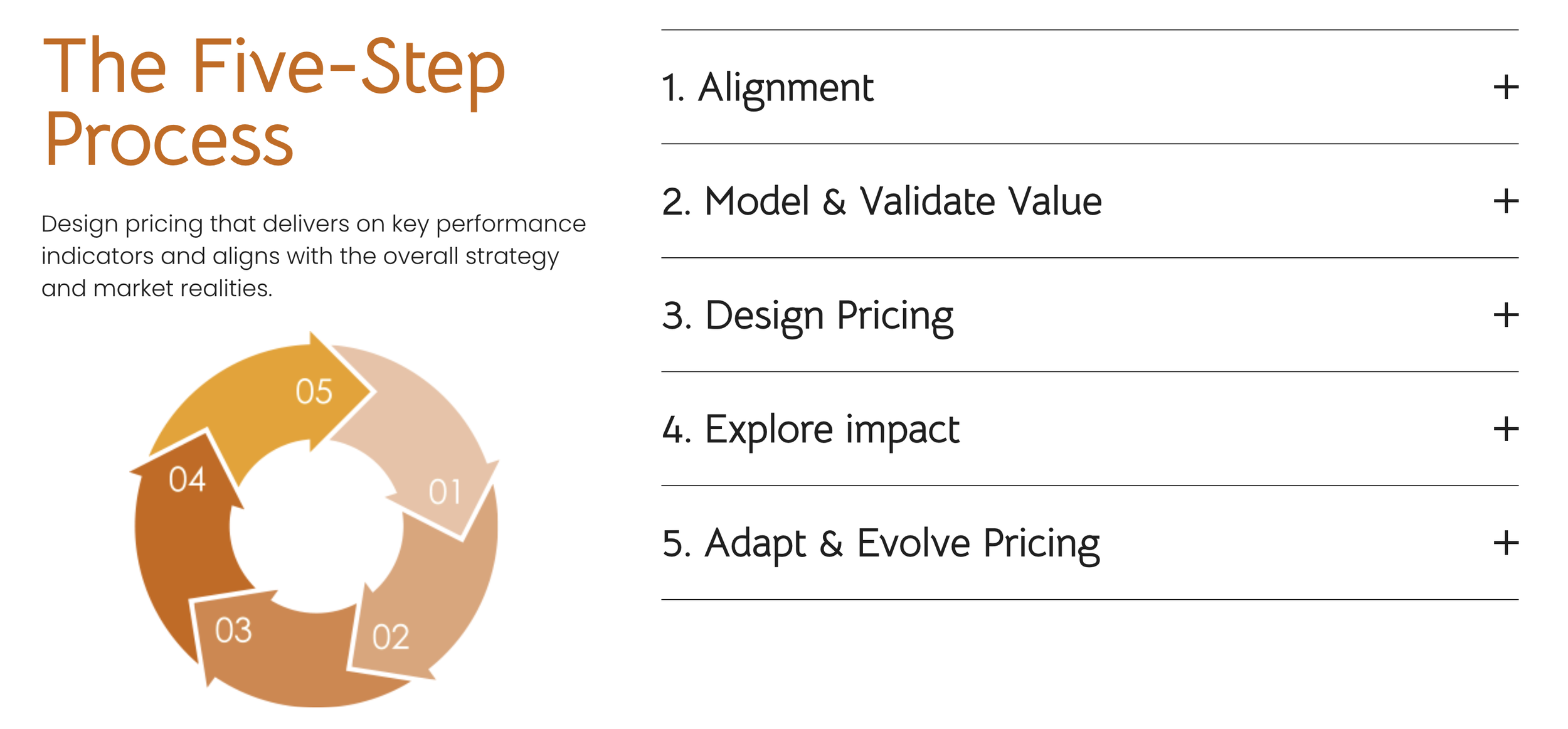
Ibbaka’s process is really a cycle
Ibbaka’s Five-Step Pricing Design - Optimization - Adaptation Cycle
Pricing Alignment
The first step in any pricing work is to align pricing with business strategy. Roger Martin’s strategic choice cascade can be reframed for use in pricing work. This first stage generally includes
Mapping of pricing to overall strategy
A strategic pricing SWOT (Strengths, Weaknesses, Opportunities, Threats)
Pricing KPI benchmarking and trends (what the pricing actions are meant to impact)
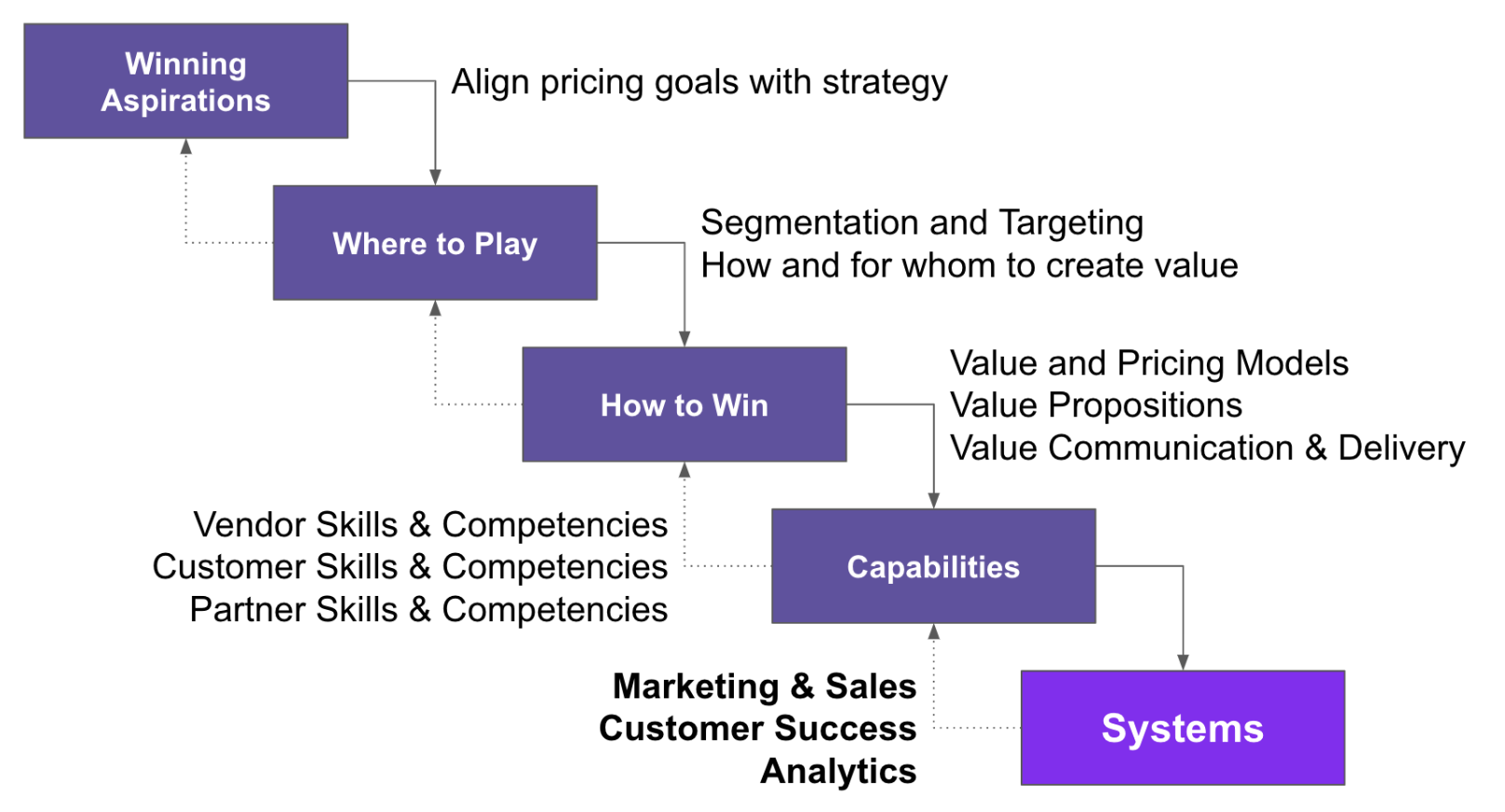
Ibbaka application of Roger Martin’s strategic choice cascade to pricing.
Model and Validate Value
This is the foundation of the Ibbaka approach. If you don’t have an actual value model, you are not doing value based pricing, just making vague promises.
A value model is a system of equations that estimates the economic value provided to a customer for a use case. See Core Concepts: Value Model.
Value models are validated in three ways:
Voice of the customer value validation interviews
Applying existing customer data to the value model
Using synthetic data to explore scaling and other model properties
Value models are dynamic and context-dependent. And they are a powerful way to provide context to generative AI.
Value can change as:
New functionality and data are added
Competitors innovate and change their pricing
Customer requirements change and new use cases emerge
Once upon a time, value models were scarce, expensive, and static. Generative AI has changed that. This is at the centre of Ibbaka’s valueIQ.ai.
Design Pricing
Once one has a validated pricing model, it is time to design pricing.
The design goals for the pricing model need to be explicit about the following:
Alignment with overall strategic goals
Positioning relative to the competition
Cost and margin goals
How price tracks value
Target value capture ratio
A pricing model includes:
Packaging of functionality and data into packages for use cases and market segments
Pricing metrics
Fences
Pricing levels
Scaling adjustments
Upsell and cross-sell inducements
Discounting rules
Pricing models don’t live in isolation. They are connected to value models and sometimes to cost models and other non-economic dimensions of value, like sustainability or health outcomes for health applications.
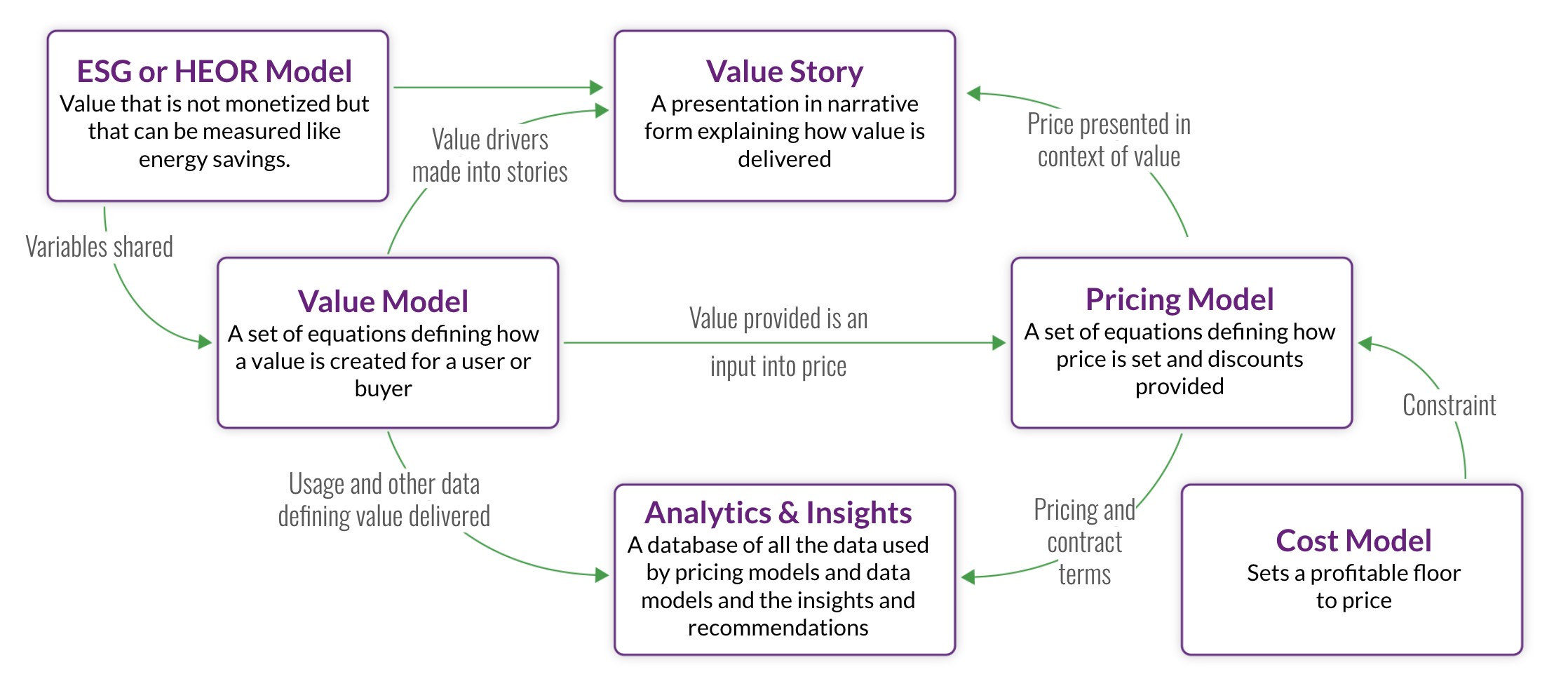
How the value model, pricing model, cost model and ESG or HEOR model all work together to shape pricing.
Some definitions
Value Based Market Segmentation: A market segment is a group of potential buyers who get value in the same (engage the same value drivers) way and who buy in the same way.
Pricing Metric: The unit of consumption for which a buyer pays.
Value Metric: The unit of consumption by which a user gets value.
Value Capture Ratio: Price / Value to Customer. The amount of value delivered is captured back in price. For B2B SaaS, normally from 5% to 20%.
Explore the Impact of Pricing Designs
Before implementing a pricing change, one needs to explore its impact.
One first does this by seeing what the price will be across the full range of scales, configurations, and discounts, and then tests the value capture ratio for each possibility. As there can be many thousands of possible situations, one generally does this through sampling. The goal is to calibrate pricing levels to align with the value capture ratio suggested by the strategic goals and to understand where edge cases come into play.
One normally begins by applying the new pricing model to existing customers and seeing what the impact is. Ask how
Pricing changes for each customer (look at absolute price changes and percent price changes)
Value capture ratios change
Work with sales to estimate the impact of price changes on pipeline metrics and the win/loss ratio
Net Revenue Retention may be impacted

When investigating a new pricing model segment the customer base by value to vendor and value to customer.
Sometimes this is not enough, and one wants to test pricing against different possible futures. Scenario planning is the best way to do this. When applying scenario planning to pricing, one basically identifies key critical uncertainties, combines them to create scenarios, and then asks how the proposed pricing model will perform under each scenario.
Some common scenarios to explore include
Competitor responds with price cuts or discounting
New competitor with a different value proposition and/or pricing model enters the market
Customer segments change (and with them the value model)
Overall economic conditions change
It is usually difficult to answer all of these questions with existing data. One can go out and do additional research. OpenAI used a van Westendorp study to devise the initial pricing for ChatGPT (see Pricing AI assistants for productivity suites: survey results).
In most cases, though, this is going to be expensive, impractical, or both. Increasingly, companies are turning to the use of synthetic data to explore value and pricing. One can increasingly get better approximations of how real buyers and users will respond by using avatars. Ibbaka has developed ways to generate high-fidelity data for pricing research and testing.
Adapt and Evolve Pricing
That was a lot of work. Coming up with a new pricing model requires one to build and validate a value model, design the pricing, and then test the implications before rolling it out to the world. The new pricing needs to be introduced to the market (influencers, analysts, and buyers). A plan needs to be in place to migrate existing customers into the new pricing (a major effort in itself).
That is not the end, though. It is just the beginning. Any pricing action is likely to provoke a response from competitors, and customers can respond in unexpected ways. In many cases, a new pricing model actually opens a solution to new customers and changes the market dynamic.
Given these feedback loops, pricing design needs to be adaptive. A system needs to be in place to detect market signals (from competitors and customers), know how critical uncertainties are resolving (scenario planning is part of adaptive pricing), predict performance of key pricing indicators, and take early action (lead and shape pricing, don’t follow and respond).
Pricing is a cycle, not a process. The work does not stop, but well-managed, each step builds on what was done before, and it trips around the cycle, gets faster and more effective.
American cyclist Greg LeMond was right: “It doesn’t get easier, you just go faster.”
Sign up for the valueIQ beta to get early access
Navigating this new landscape? Want to benchmark your pricing strategy?
📩 info@ibbaka.com—the inbox is open.
Buckle up. The billing wars just went agentic.
