


Steven Forth is a principle at Ibbaka and valueIQ. Connect on LinkedIn

On October 16 we hosted a webinar with Brandon Hickie and Companyon Ventures. Brandon led us on a deep dive into credit based pricing.
You can listen to the webinar here. The New Currency How Credit Models Accelerate Growth
Brandon covered some key topics in this webinar. Here are some of the takeaways.
What is an agent?
An agent is a logic based system that autonomously drives a workflow and the decisions around it. An agent takes in its environment and has reasoning tied to it.
This is different from an assistant, an AI application like a co-pilot that is prompted to take an action.
What is credit based pricing?
Credit-based pricing is a flexible way to pay for a product or service using credits instead of fixed fees. Customers buy credits upfront and can then use them however they want—whether that’s to unlock certain features, run reports, boost capacity, or use other parts of the platform.
Because each action uses up a known number of credits, it’s easy to track how much you’re consuming and manage costs along the way. This model gives customers more control and aligns pricing with usage and, when well designed, with value.
Credit-based pricing can also work alongside other models—like seat-based or subscription pricing—to create hybrid options that combine predictability with flexibility.
What are the main objections to credit-based pricing?
See Five objections to credit-based pricing and how to manage them for detailed discussion.
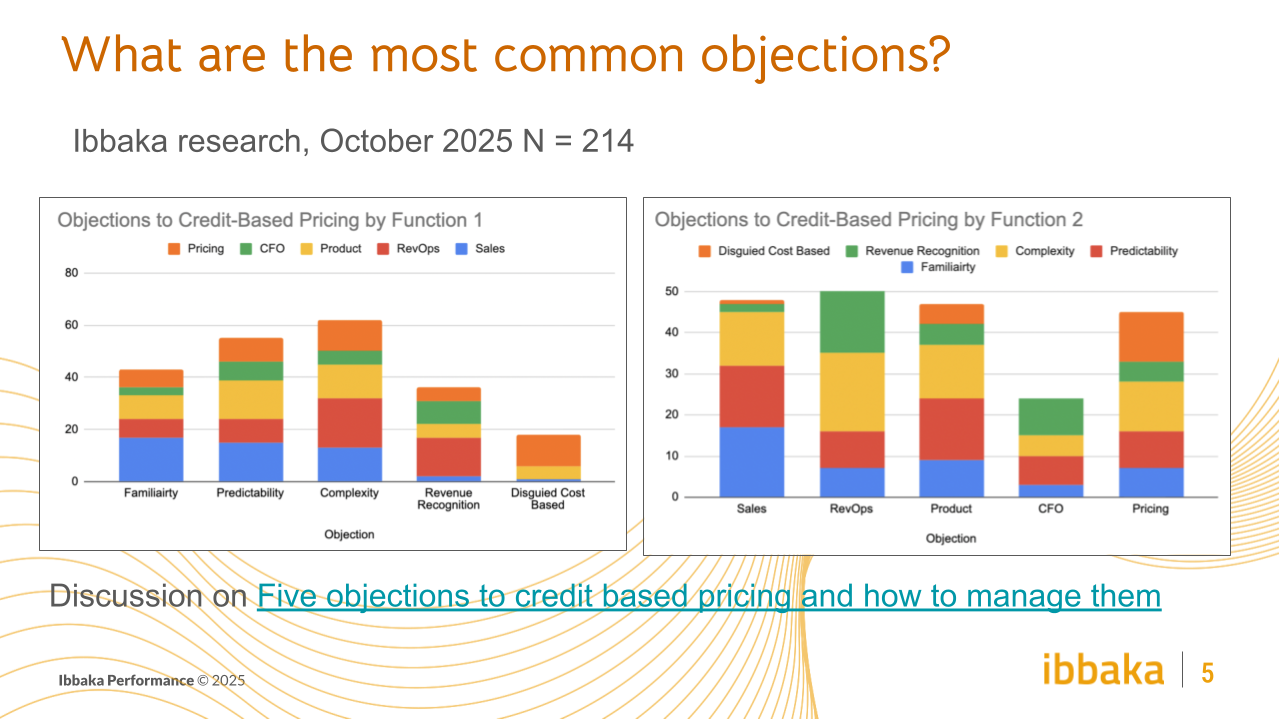
From the The New Currency Model webinar. October 16, 2025. Research from October 1 to 5 2025. N = 214.
The top objections by function are …
Sales: Familiarity, Predictability, Complexity
Revops: Complexity, Revenue Recognition, Predictability
Product: Predictability, Complexity, Familiarity
CFO: Revenue Recognition, Predictability, Complexity
Pricing: Complexity, Disguided Cost Based, Predictability
Why credit based pricing for AI agents?
There are four key reasons:
Many agents and AI applications have diverse use cases and it is unclear which use case will dominate. Pricing needs to be flexible and adaptive.
Credit based pricing can be used to make sure that pricing stays above costs, and compute costs can be significant for agents.
Large companies like Salesforce are showing that this can work and that the market will accept credit based pricing.
Design patterns are becoming established and supporting applications are beginning to appear.
Who is doing a great job with credit based pricing?
Clay - Built from ground up and have an elegant solution with a common credit system across all functionality.
Zendesk - Was in trouble, reinvented itself with AI, allowed a flexible transition from seats to AI credits and back, removing risk.
Servicenow - Large variance in use cases, stayed true to their core while introducing new services and credit based pricing to pay for these services.
Google Gemini - Layering AI into workflows and pricing premium solutions.
OpenAI - Clever use of credit capping to drive upgrades.
Design considerations for credit based pricing models
On the design of credit based pricing
“Talk to your peers. See what other people are doing. See what is working and what is not.”
The key decision is defining the metric for the credits. How granular should credits be.
Outcomes are generally hard to define and measure. If you can map credits to outcomes good, but most companies will struggle to do this. The best place to start is with value. One credit should represent about the same amount of value (this is not an exact science) no matter how it is used. This requires a formal value model to think through.
Credits can be for either capacity or consumption. Make sure you are clear on what you are doing.
Design an adaptive system. Assume that key parameters in your model will change.
Number of credits included in each package
Number of credits consumed by each action
Price of additional credits that can be purchased
Rules for roll over (what happens to unused credits)
Rules for pooling and reallocation (can credits be transferred between users)
Make sure that your billing and finance systems can be set up for the credit model.
Think three steps ahead of the market.
See also A guide to the design of credit-based pricing for AI agents.
The future of credit based pricing
We believe that credit based pricing is here to stay, and that it will become one of the standard ways to design pricing. It is not just a transitional thing as use cases, compute costs and value for AI applications gets better defined.
Brandon has two predictions on the future of credit based pricing.
The major ecosystem players will introduce credit models where credits can be applied across all the agents and applications in their ecosystems. This will only happen when buyers begin to complain that there are too many different credit systems and this becomes a barrier to sales and adoption.
A new layer will be added to the pricing and billing technology stack to manage credit systems. This is similar to what has already happened in the video game industry where there are applications to manage the behind the scene economics of the games.
Interesting times in the pricing world. Credit pricing models are a new opportunity and challenge. They will change how we connect value to price and how we are able to evolve pricing models —- which are rapidly becoming pricing systems.
Navigating the new pricing environment brought by AI agents? Contact us @ info@ibbaka.com
