
THE VALUE & PRICING BLOG | Latest Insights & Pricing News from Ibbaka

Finding it difficult to segment your market? Your offer may be undifferentiated.
Good market segmentation brings together customers that buy the same way and get value from a product or service offering the same way. It ensures optimized use of an organization’s resources through targeting customer segments who derive value from the offering in a way that is in alignment with the organization’s objectives of maximizing revenue, profit or margin at a reasonable cost to serve. Market segmentation is the foundation of value-based pricing. In value-based pricing the goal is to capture a fair share of the differentiated value of an offering relative to the customer’s next best competitive alternative.

How will the end of Net Neutrality impact pricing for B2B SaaS and the Industrial Internet of Things?
The US FTC will probably abandon the principle of Net Neutrality. This will lead to new pricing options for ISPs, application providers and content providers. It is time to start developing scenarios for the impact this will have.
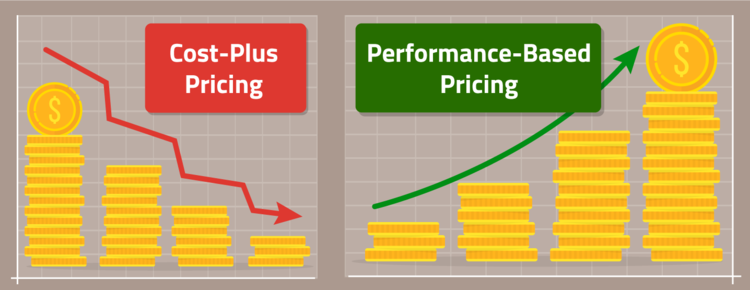
Sometimes cost-plus pricing is your best option
Cost plus pricing is the best pricing method when the customer has control of the deliverables and when only the customer can know the value of the offer.

When to worry about costs in pricing
It is a truism among pricing experts that you should not base your price on your costs. Your costs are your problem, not your customer's. It is up to you to manage costs relative to the value you provide and the customer's willingness to pay. This sounds good in theory, but anyone who has run a business knows that costs matter. They matter a lot. Costs cannot be ignored when one is thinking about pricing strategy.

Pricing Power. What it is. How to get it.
Many of our customers put pricing and growth as central to their strategic plans. Understanding pricing power begins with understanding differentiated value provided to customers and then investing in critical actions to communicate and capture it.

Make pricing your strategic edge in 2018
Many of us are now deep in strategic planning for 2018. We are defining goals, setting priorities and marshalling resources. What role will pricing play in your 2018 strategy?

In early-stage innovation the product manager should drive pricing decisions
Who should own pricing decisions? There are as many opinions on this as there are pricing experts. For good reason. The answer to this question depends on the company's goals and organizational structure, and on just where the product is in the lifecycle.

What role will AI play in pricing?
Big data, predictive analytics, artificial intelligence (AI) and machine learning are all the rage these days. They are sure to be a popular topic of hallway conversations at this October's Professional Pricing Society Fall Conference in San Diego (Oct. 24 to 27, 2017). The theme for the conference is 'Data, Change Management and the Profit Landscape' and there are a number of interesting sessions on these themes on the agenda.

Pricing on the adoption curve - early stage innovations
If you are in technology marketing, you are probably familiar with Geoffrey Moore’s Maturity Life Cycle. Moore looks at how a technology product’s market evolves over time. This post explores concepts on pricing across the product maturity curve

Key business questions for pricing excellence
Ibbaka helps you execute on value-based pricing. This is a pricing strategy where your price is based on the differentiated value you provide to your customers. The alternatives to value-based pricing are cost-plus pricing (good for contracts where the deliverables are poorly defined and controlled by the client), transactional pricing (what happens with commodities), market following pricing (if you have little pricing power) and various forms of auctions (growing in importance as M2M pricing becomes more common).

When is 'user pricing' a good pricing metric?
User-based pricing has gotten a lot of bad press recently. It is generally seen as a lazy pricing metric, used by companies that have not thought deeply about their value metric and how to connect the pricing to value. But there are many cases when user-based pricing is the best metric and should be used.

The Price of Data in the Underground Economy
Monetizing data is a growing topic of conversation globally. The proliferation of data and the Internet of Things (IoT) is providing a lens into understanding customer usage like never before. One that will help drive innovative models for data monetization. Yet, one cannot discuss the opportunities that come with big data without thinking about data security.

Understanding Customer Value Creation and Usage to Determine Price
Understanding how a product or service offering creates differentiated value for the customer is the foundation of value-based pricing. Prices should align with the value the customer receives, thus ensuring the seller is maximizing returns from the customers and target the customers that derive the most value from the offering. These are the customers that will be happiest and most successful, the kind of customer you want to build a business on. For pricing to be effective, it should track the value metric. This is the unit by which the product or service offering is consumed that best reflects how the customer gets value.

How, Where, When and Why - looking inside Service Design
The world of Service Design—an interdisciplinary skill that blends elements from various fields such as user experience, systems design, marketing, and psychology to optimize new services. Explore its key principles and associated skills, and learn how Ibbaka enhances collaboration in this innovative domain.

Why and who is Ibbaka?
The people who came together to form Ibbaka have a long working history of working together. We have built companies together, organized communities of practice and even put on a few conferences. We know how each other work and how we learn.
Managing discounts in B2B SaaS
Discounting can be a touchy subject. Sales people often claim that discounts are required to make the sale. Pricing is philosophically opposed to discounts as they undermine profitability and signal lack of pricing power. Marketing worries about how discounts will impact value perception but at the same time desire the increased attention that a well-managed discount campaign can generate. How do you manage all of these different imperatives?

Introducing the LinkedIn Group on Pricing the Internet of Things
We are opening a LinkedIn Group on Pricing the Internet of Things. Why do this? There are many excellent LinkedIn groups on pricing. The Professional Pricing Society has a particularly good one and we are active on it. There is also a good group Internet of Things Strategy and Innovation. So why another LinkedIn Group?

How does Ibbaka price Ibbaka's services?
One of the best questions we are asked is 'OK, you are pricing experts, so how do you price your own services?'
A fair question and we don't answer this by giving a price. We advise our clients not to get into a price discussion until they have established value. We follow that advice ourselves!

Enabling Value-based Selling with Rapid Targeting
Much of the work we do at Ibbaka is centered around value-based pricing. In one of my previous posts, I reviewed one of the key inputs of pricing strategy—market segmentation. Now, I would like to explore another critical business process—value-based selling. How can we enable our sales people to practice value-based selling?

The SaaS Freemium Trap - Photobucket vs Meetup
The freemium revenue model is the go-to-market strategy for many web-based software solutions. Unfortunately, it can turn into a costly trap for the service provider. We saw this happen in June of this year with the Photobucket freemium to fee-based service migration debacle. Let's delve into what went wrong with Photobucket's fee introduction and contrast this with the lessons to be learned from Meetup's successful migration to a paid subscription model.
Never miss an update
Subscribe to the Value & Pricing Newsletter to get insights that help you supercharge your growth.
