

Steven Forth is a Principle at Ibbaka and a founder at valueIQ.ai. Connect on LinkedIn.

TL;DR (Too Long; Didn’t Read Summary)
API management is critical to the data-driven, agent-based economy, with APIs serving as the backbone for integrating focused AI agents and accelerating innovation.
Rapid API adoption and monetization—especially with usage-based models—are now viewed as key to growing revenue and expanding addressable use cases.
Accelerating developer onboarding and investing in seamless, low-code integrations are essential for capturing incremental business value and customer ROI.
Consolidating API management, integration, and monitoring tools into unified platforms drives operational efficiency and scalability, reducing costs and IT overhead.
Investing in partner and developer ecosystems—via self-service onboarding and robust documentation—fosters ecosystem growth and compounding monetization effects.
Strong centralized controls for security, compliance, and resilience are now baseline requirements, supporting customer trust and innovation.
Preparing for multi-cloud and hybrid environments maximizes strategic optionality and future-proofs API infrastructure for rapid shifts in technology or vendors.
Thirteen key value drivers (e.g., adoption velocity, integration time-to-value, monetization, ecosystem growth, operational efficiency) define category leadership in API management.
Emerging Agent-to-Agent (A2A) and Model Context Protocols (MCP) from Google and Anthropic complement traditional APIs, enabling higher-level agent orchestration and interaction while maintaining compatibility with existing tools and security frameworks.
Leading vendors such as Kong, MuleSoft, Google Apigee, Gravitee, and Amazon Bedrock are pioneering in both traditional API management and next-gen agent protocols, consolidating control and maximizing ecosystem value.
API management is more important than ever in the agent economy.
See Competition for data control will push API prices higher.
AI agents are fed on data. Many agents generate their own data. Agents communicate with each other through data (well, shared prompts too, but one can think of prompts as a form of data). Agents generally offer more focused functionality and targeted goals than the bloated enterprise applications they are replacing. This is part of their power. But it also means that agents have to work together. APIs are the key to how agents will interact in the real world.
Ibbaka has just published a new Category Value Report on API Management. This is the 4th in this series where we use generated value models to understand the positioning of vendors in a category. We expect to publish two more reports by the end of the year.
Category Value Report: Internal Talent Market Places and Skill Management
Category Value Report: API Management Systems (published October)
Category Value Report: Billing and Payment Management Systems (coming in November)
Category Value Report: Vibe Coding Platforms (coming in December)
Insights & Actions from the Category Value Report
Accelerate API Adoption to Drive Revenue
Prioritizing rapid API deployment and consumption will significantly expand addressable use cases and generate new revenue streams; investing in developer experience and onboarding is crucial for capturing incremental business value.
Optimize Integration for Faster Time-to-Value
Compressing the time from API design to integration reduces revenue recognition delays and improves operational agility; leveraging platforms that enable seamless, low-code integrations can pull forward customer ROI and utilization.
Monetize APIs with Usage-Based Models
Direct API monetization through advanced packaging, metering, and billing (e.g., usage-based/plan models) unlocks new revenue—executives should foster commercial models where API consumption is aligned to customer value.
Consolidate Toolchains for Operational Efficiency
Streamlining API management, integration, and monitoring tools onto unified platforms drives cost savings, improves scalability, and reduces IT overhead—platform consolidation should be a near-term strategic focus.
Invest in Developer and Partner Ecosystems
Enable self-service onboarding, robust documentation, and partner dashboards to shorten integration cycles and accelerate ecosystem growth; a flourishing developer or partner network amplifies adoption and creates compounding monetization effects.
Strengthen Security, Compliance, and Resilience
Centralized controls, automation, and analytics are now baseline requirements to reduce regulatory, breach, and downtime risks; investing here is foundational for innovation, customer trust, and future market flexibility.
Maximize Strategic Optionality and Multi-Cloud Readiness
Building for flexibility—such as multi-cloud/hybrid capabilities and rapid replatforming—ensures the organization can pursue new markets, adopt emerging tech, or switch vendors quickly as conditions evolve; future-proofing infrastructures now is key to resilience and growth.
Solutions covered
Kong (multi-cloud, AI gateway, scalable performance)
WSO2 (open-source, full lifecycle API management)
Gravitee (universal governance, event-driven APIs)
Tyk (cost-effective, open-source, AI-powered)
Axway (catalog-driven integration, EDI/API integration)
Jitterbit (integration, lifecycle, monitoring, AI automation)
Azure API Management (enterprise scale, security, analytics)
IBM API Connect (enterprise governance, developer portal)
Mulesoft (integration, modernization, unified governance)
Apigee (Google) (scalability, analytics, policy enforcement)
Common value drivers in API management
Our analysis found 13 value drivers common across all of the solutions covered. The full report includes the value driver subscriptions and equations.
Here is a list of the value drivers:
API Adoption Velocity
Integration Time-to-Value
Working Capital Efficiency (Cycle Time/Receivables/Cash Flow)
API Monetization Enablement
API Product Revenue/Launches/Enablement
Partner Ecosystem/Developer Self-Service/Onboarding
Lower Run Cost/Infrastructure Cost Reduction
Deferred Infrastructure/Capacity/Hardware Spend
Consolidated Tooling/Operational Efficiency
DevOps/Integration Productivity/Labor Efficiency
Incident and Outage Reduction
Compliance/Audit/Breach Cost Avoidance
Strategic Optionality/Flexibility/Multi-Cloud
How the value drivers fit together
One of the key insights from category value maps is the interactions between value drivers. We do this through a DSM or Design Structure Matrix. This clusters value drivers into the buckets of value that buyers are looking for.
One important class of value driver is the ones that overlap in two categories. For API management, there are two.
Partner Ecosystem/Developer Self-Service/Onboarding - connects Cluster 1 (Revenue, Adoption, Monetization) and Cluster 2 (Cost, Labour, Tooling, Infrastructure Optimization)
Compliance/Audit/Breach Cost Avoidance - connect Cluster 3 (Risk Mitigation) and Cluster 3 (Strategic Optionality)
API management vendors should make sure they are implementing functionality that differentiates them on these two key value drivers.
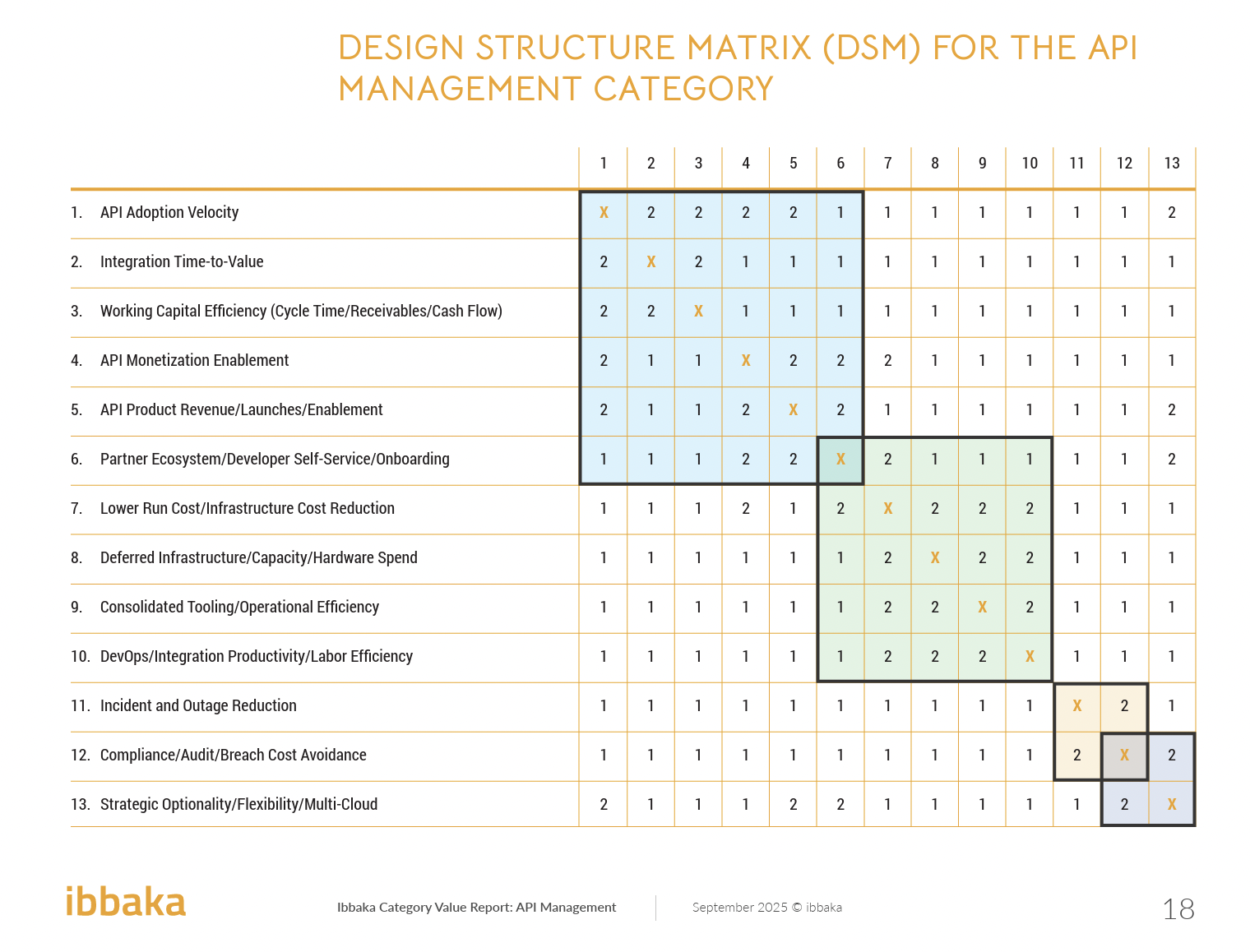
From Ibbaka Category Value Report: API Management Systems, September 2025.
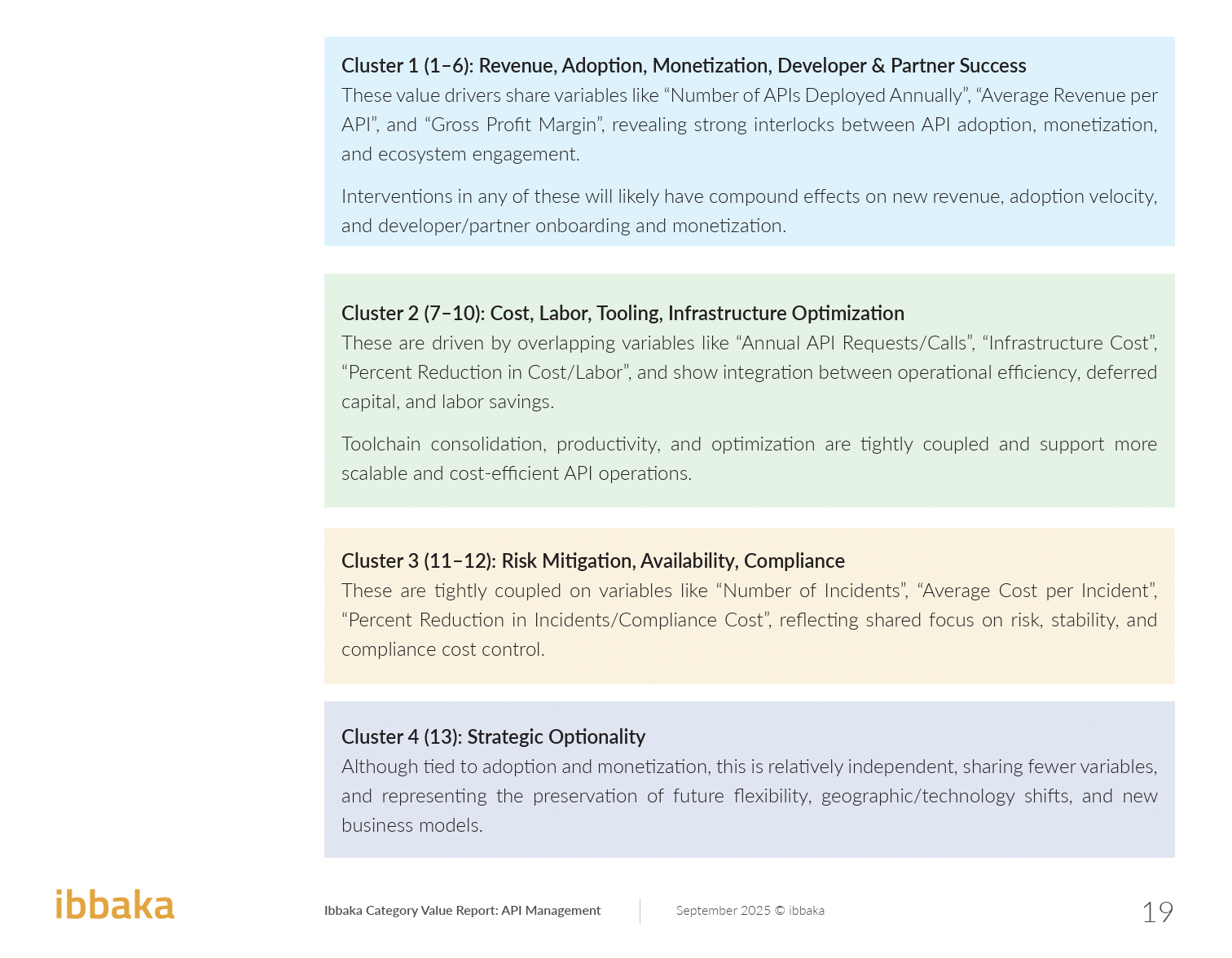
From Ibbaka Category Value Report: API Management Systems, September 2025.
Role of A2A and MCP and comparison with APIs
Some people in agent land are questioning the role of APIs given the emergence of the Google A2A (Agent to Agent) protocol and the Anthropic MCP (Model Context Protocol).
Both MCP and A2A protocols are designed to complement traditional REST APIs rather than replace them. They operate at different layers of the technology stack:
Traditional APIs continue to handle direct system-to-system integration
MCP standardizes how AI agents access these APIs and other tools
A2A enables coordination between multiple AI agents that may each use MCP internally
MCP and A2A both utilize JSON-RPC 2.0 over HTTP/HTTPS, making them compatible with existing web infrastructure. This design choice enables:
Seamless integration with current API management platforms
Reuse of existing security frameworks like OAuth and OpenID Connect
Compatibility with standard web protocols, including Server-Sent Events for real-time communication
The most powerful implementations combine both protocols in a hierarchical architecture:
A2A Layer: Manages high-level communication between different AI agents
MCP Layer: Handles internal agent access to specific tools and data sources
Traditional API Layer: Provides the underlying system connectivity
Kong has emerged as a pioneer in MCP integration, launching comprehensive support for both protocols:
Kong MCP Server for Konnect: Enables AI agents to discover and analyze API configurations, traffic analytics, and control planes
Kong AI Gateway: Provides enterprise-grade security, observability, and governance for MCP servers
Comprehensive policy support, including rate limiting, content filtering, and access control specifically designed for MCP interactions
MuleSoft has introduced "Governance for Agent Interactions" with native support for both MCP and A2A protocols:
Anypoint Flex Gateway: Extended to support MCP and A2A server management
Specialized policies: Including A2A Agent Card rewriting, PII detection, and schema validation
Unified governance: Treating agent interactions with the same rigor as traditional API management
The adoption extends beyond individual vendors to platform-wide integration:
Postman: Launched a remote MCP server enabling natural language API workflow automation
Amazon Bedrock AgentCore Gateway: Provides native MCP support with automatic API-to-MCP conversion
Google Apigee: Positioned as the "air traffic controller" for A2A agent networks, managing security and traffic flow
Gravitee Agent Mesh: Offers governance for both A2A and MCP protocols
Conclusions
API management plays a central role in enabling and monetizing the agent economy, where AI agents rely on data exchanges facilitated through APIs, replacing bulkier enterprise applications with targeted, collaborative functionalities. The analyzed value drivers—ranging from adoption velocity and integration time-to-value to monetization, partner ecosystem growth, cost reductions, risk mitigation, and strategic optionality—show API management is foundational to driving faster revenue recognition, operational efficiency, and market flexibility.
Platforms that accelerate developer onboarding, prioritize integration speed, consolidate toolchains, foster ecosystem growth, and strengthen security emerge as leaders in maximizing both commercial and strategic value. Efficiency gains, new revenue streams from usage-based API models, and future-proofing via multi-cloud readiness are critical competitive differentiators identified throughout the report.
The shift toward agent-to-agent (A2A) and model context protocols (MCP)—such as those championed by Google and Anthropic—signals complementary advances but not replacements for APIs; interoperability, governance, and security remain core to robust agent-driven architectures. Market leaders like Kong, MuleSoft, Google Apigee, Gravitee, and Amazon Bedrock are rapidly adopting these protocols, consolidating API and agent management to drive greater value and resilience.

Navigating the new pricing environment brought by AI agents? Contact us @ info@ibbaka.com
